Understanding Earth’s Cycles: Weather, Climate, and Seasons
A 3-Day Summer Professional Development Institute for Grades K-5 Educators
July 7th-9th, 2025
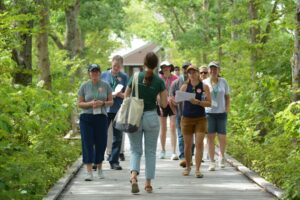 Understanding Earth’s Cycles: Weather, Climate, and Seasons brought elementary science educators from across New England together for three days of engaging and immersive learning that balanced pedagogy, science content, and classroom activities. With a particular lens of the intersection of seasonality and life’s cycles, known as phenology, participants considered how to bring nature and its cycles inside (and out of) the classroom.
The Institute’s first partner was the New England Botanic Garden at Tower Hill, where participants spent the first two days. On Day 1, after a tour of the picturesque garden, educators engaged with the Science and Engineering practices, seasons of change, animal adaptations, and weather patterns. Terrariums were built, data was collected and analyzed, and classroom activities were planned. The group also took a hike to the nearby pond to consider different New England ecosystems.
 On Day 2, educators learned about phenomena-based learning with an immersive “student hat” experience about having access to fruits and vegetables on a school menu all year round. After learning more about their final projects, participants learned about the life cycles of plants with engaging classroom activities and the climate garden at the Botanic Garden. With live animals in tow, a guest speaker from EcoTarium came to speak more about animal adaptations specific to New England fauna. To wrap up at Tower Hill, participants considered the water cycle, the human water filtration system, and engaged in a water filtration challenge.
For the third and final day, the Institute shifted locations to the verdant Harvard Forest in Petersham, MA. In the century-old diorama room contained in the Fisher Museum, participants started their day learning more about the background of Harvard Forest and their research. Using multiple samples from various trees in the forest, participants learned about how trees can be identified depending on the distinguishing features of leaves. Educators then spent some time nature journaling with the option of a Phenology Wheel, which could be used in the classroom throughout the year. In the afternoon, participants got to take a hike into the vast forest, climb an observatory tower that surpassed the forest canopy, and reflect on the history of land management practices and their effects on the forest today.
Thank you to New England Botanic Garden at Tower Hill, Harvard Forest, and the EcoTarium for their participation during this institute!
Collaborating Partners:
New England Botanic Garden at Tower Hill
Harvard Forest