Resilient Coasts: Using Local Phenomena to Understand Climate Solutions
A 3-Day Summer Professional Development Institute for Grades 6-12 Educators
 The Wade Institute was proud to partner with The Trustees of the Reservation at Crane Estate for the North Shore Summer Professional Institute this year. Val Perini, the North Shore Educator Manager, bringing her many years of coastal habitats and environmental education, organized an informative, fun, and engaging 3-day institute on coastal habitats and resilience efforts.
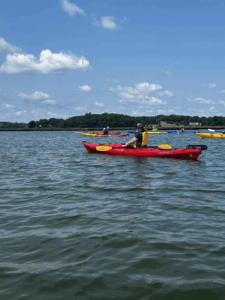
On the first day, participants started the program off with a kayaking trip on Castle Neck River, where they learned about Choate Island, the estuary, and the non-Atlantic side of Crane Beach. After stopping at the southern side of the beach, participants conducted a wrack line survey before heading back. In the afternoon, after touring the Great House on top of the hill, Trustee Coastal Ecologist Jeff Denoncour led participants through a guided tour of the many habitat communities in a dune ecosystem.
On Day 2, participants met Lead Coastal Ecologist in one of Crane’s many salt marshes to learn about the many unique species that inhabit the marsh as well as the efforts to restore the Great Marsh. After heading back to the beach, participants linked up with Ian Hayes, a volunteer and citizen scientist, who is conducting long-term data collection research of the Crane beach profile, and got the opportunity to collect beach profile data using the Emery method. In the afternoon, the group engaged with an immersion activity to experience phenomena-based instruction, following up with an analysis and reflection on the approach in relation to their practice.
 To conclude the program, participants engaged in another immersion activity to experience 3-Dimensional Sensemaking. Meeting up with yet another expert, Lori Lafrance, a local HS Environmental Science teacher, teachers had the opportunity to learn about MassAudubon’s Salt March Science Initiative and collecting field data in one of many salt marsh sites. In the afternoon, participants concluded their pedagogical sessions with a session on the Science and Engineering Practices, focusing on SEP4: Analyzing and Interpreting Data.
Full of engaging activities across the Crane Estate, multiple opportunities to learn from scientists in the field of coastal ecology, and immersion experiences that teachers could use in their classrooms, this 3-day institute was the perfect balance for a summer professional development session.

The Trustees of Reservations